
Our Terrible Lizards review: a six-to-ten-hour first-person parkour horror game with a great setting, thin combat-free chases and a fair $24.99 price.
Terrible Lizards Review: A Short, Sharp Mascot Horror Game
Quick answer: Terrible Lizards is a good $19.99 launch buy and a fair $24.99 one. It is a first-person horror game built around parkour chases, not combat, and it runs six to ten hours. The setting — a failing Route 66 dinosaur attraction in 1992 — is one of the best in the mascot-horror wave, and the movement is more generous than the genre usually allows. The trade-off is a short campaign, a small enemy set and chase sequences that can turn into trial-and-error.
It is not a game for players who want weapons, a long campaign or a tidy explanation. It is very good at making a dead theme park feel like a place that was alive.
What Terrible Lizards is
Terrible Lizards is a first-person horror parkour game developed by WDR Studios and published by Digital Pajamas and Behaviour Interactive. You play Jordan, a motorist whose car dies on Route 66. He walks to Dalton's Dinos, a roadside attraction that has been abandoned mid-season, and finds a phone call from a woman asking him to find a missing child.
The game takes place on 19 September 1992. No cell phones, no internet, no help. The park is the only building for miles, and the underground complex beneath it is larger than the visitor areas suggest.
There are no weapons. The loop is run, jump, climb, wall-run, bounce and slide. Creatures chase you; you do not fight back. The closest comparisons are first-person chase horror and parkour platformers, not survival horror with an inventory.
Official source: Terrible Lizards on Steam Official source: Digital Pajamas press page
The setting is the best thing in it
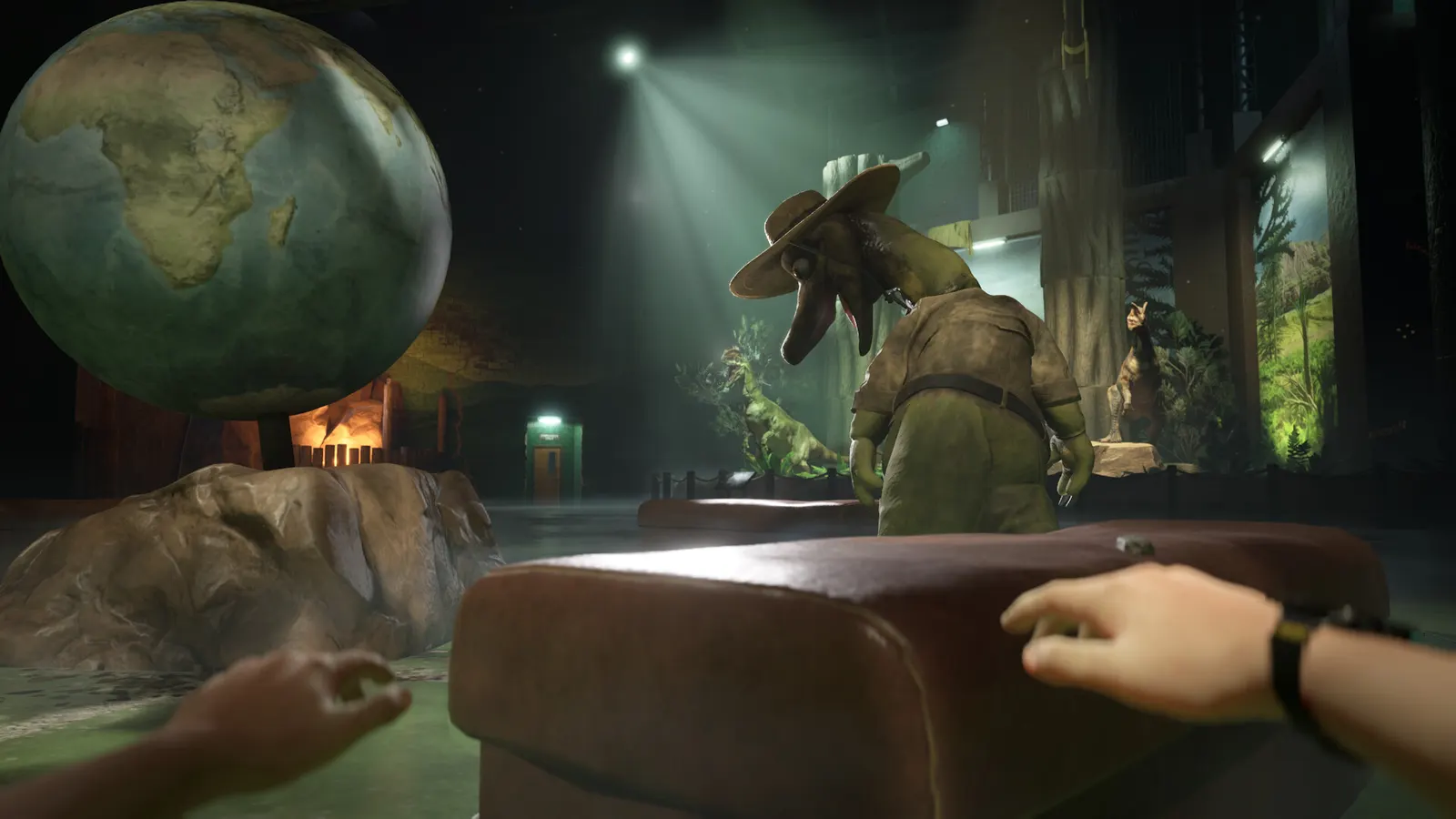
Dalton's Dinos is a fictional attraction, but it is built from recognisable parts: a museum with a duelling-dinosaurs centerpiece, a gondola, a crew lift, flooded electrical rooms, mining outposts and backstage corridors that smell like old carpet. The park is past its prime. The interstate diverted traffic, the crowds thinned and maintenance slipped.
The game tells its story through signage, tapes, letters and rooms designed for visitors who are no longer there. There are no cutscene dumps. Dalton's recordings and Elena's letters supply the history, and the state of the park supplies the rest.
That environmental storytelling is the strongest reason to play. The museum is impressive; the backstage areas are not. The contrast between the public face and the working scientific site is the game's visual thesis, and it holds up for the whole run.
The parkour works
Movement is momentum-driven and forgiving. Jordan can climb most ledges, wall-run across gaps, bounce off surfaces and slide under obstacles. The game rarely blocks a route with a precise jump; it wants you to keep moving, and the best chases feel like a route you are improvising rather than a sequence you are memorising.
The no-weapons rule is a design choice, not a limitation. It makes every encounter a movement problem, and it keeps the tension high without an ammo economy. The downside is enemy variety: the creatures shamble and charge, and the game does not introduce enough new behaviours to reset the fear across four chapters.
The game checkpoints generously around chases, but a failed sequence can still cost a minute of climbing. If a chase feels impossible, look for a side route rather than the obvious one; the levels usually have two.
Where it slips
The campaign is short. Six to ten hours is the developer's range, and most reviewers land in the middle. A 100% cleanup run is closer to 12–15 hours. If you measure value in hours per dollar, $24.99 is fair but not generous.
The ending explains less than some players want. Dennis, the biomass and DJ's condition are resolved emotionally rather than mechanically. The game confirms what happened; it does not confirm what Dennis is. That is deliberate, but it will frustrate wiki-minded players.
Technical roughness exists. Reviews mention hitches in chase sequences and the occasional broken trigger. Patch 1.0.9 fixed a title-screen softlock and a Stella call lock, which addresses the worst cases. The platforms page tracks the patch state by platform.
The horror is more tense than scary. The mascot design is unsettling, but the game relies on pursuit rather than gore or jump scares. Players who want a pure horror payload may find it soft.
How it compares to the reviews
The critical reception is positive but not unanimous:
| Outlet | Score |
|---|---|
| CGMagazine | 8/10 |
| Loot Level Chill | 8/10 |
| Noisy Pixel | 8/10 |
| digitalchumps | 7/10 |
| Metacritic | 78 (4 critics) |
| OpenCritic | 7.3 (9 critics, 56% recommended) |
Metacritic labels 78 as "generally favourable". OpenCritic's 56% recommendation rate is lower because the same strengths — shortness, ambiguity, chase repetition — read as weaknesses to some reviewers. The user score sits around 7.1 from a small sample, which is consistent with "good, not beloved".
The spread is useful: nobody is calling it broken, and nobody is calling it a genre classic. It is a well-made short game with a specific hook.
Should you buy it on PS5, Xbox or PC?
The content is the same on all three. The differences that matter:
- PS5 has 16 trophies including a platinum. The store lists basic controller remapping and subtitle/caption support. DualSense haptics are not documented.
- Xbox Series X|S is on Game Pass at launch. If you subscribe, that is the cheapest way to play, and the achievement list is 1,000G.
- PC has the most flexible performance options and the 15-achievement Steam list. The Steam Deck rating is not verified.
The price page covers the launch discount and the refund window. The how long to beat page breaks the campaign down by chapter.
Verdict
Buy it if: you like first-person chase horror, you want a short game you can finish in a weekend, and the 1992 roadside-attraction setting appeals to you.
Wait for a sale if: you need combat, you want a 15-hour campaign, or you dislike trial-and-error chases.
Skip it if: you need a clear monster explanation or you are sensitive to motion sickness. The parkour is fast and the camera moves a lot.
At $19.99, Terrible Lizards is an easy recommendation for the genre. At $24.99, it is still worth it, but the length and the thin enemy set are real caveats.
FAQ
Is Terrible Lizards worth it? Yes for fans of first-person chase horror. It is short and technically rough in places, but the setting and movement are strong.
How long is the story? Six to ten hours for most players, with 12–15 hours for full completion.
Does it have combat? No. There are no weapons. You run, climb and hide.
Is it on Game Pass? Yes, Xbox Game Pass from day one.
Is it scary? It is tense and unsettling rather than gory. The mascot design and the chases do the work.
Does the ending make sense? It resolves the emotional story but leaves Dennis's nature open. The ending explained page walks through it.
Official source: Terrible Lizards on Steam Official source: Terrible Lizards on PlayStation Store Official source: Digital Pajamas press page Score source: Metacritic and OpenCritic aggregate pages, checked 4 November 2026.
More Terrible Lizards Guides
Chapter 3 of Terrible Lizards: the flooded electrical rooms, all four fuse circuits, Allosaurus arena hunts and the black biomass, explained.
Chapter 4 of Terrible Lizards: the Crew Lift key in Cavern B, the final Dennis chase, the moving-structure climb and how to reach the ending.
Every major character in Terrible Lizards: Jordan, Stella, Dalton, Elena, DJ and Dr. Fellows, plus the four Paleo Pals mascots and their species.
Every collectible set in Terrible Lizards: 16 amber samples, audio tapes, notes, stuffed animals and the Chapter 2 note that most players miss.
The Terrible Lizards demo has two parts: a story section and a gameplay section. What it covers, where to get it and what carries over.
Who is Dennis in Terrible Lizards? The mascot suit, the entity under Dalton's Dinos, DJ's imaginary friend and the evidence behind the main theory.
What happens at the end of Terrible Lizards: DJ, Dennis, the Crew Lift, Stella's car and the questions the game leaves open. Full spoilers.
How long Terrible Lizards takes: 6 to 10 hours for the story, 10 to 12 for completion, chapter-by-chapter estimates and what makes runs longer.