
How the Allosaurus works in Terrible Lizards: arena hunts, charge timing, vertical escapes and why the Allo is the game's purest pressure encounter.
Terrible Lizards Allosaurus
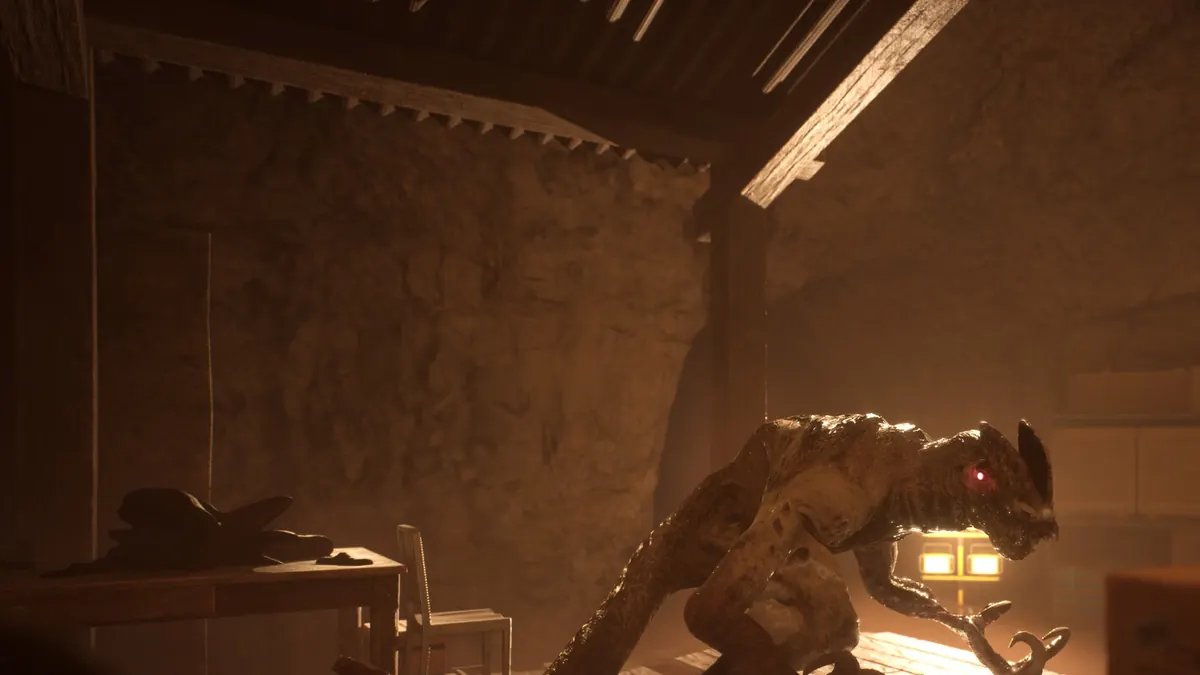
The Allosaurus is Terrible Lizards' pressure fighter. It does not stalk like the Hybrid, and it does not occupy space like the Bronto. It appears in a closed arena, circles, and closes distance in short bursts that punish hesitation. The developers have described it as "cool and lethal," which is a fair summary of how it plays.
This page covers the Allo's behaviour, the arena structure, the charge timing and the vertical routes that solve most encounters. The Chapter 3 walkthrough covers the chapter that contains most of them.
Official source: Terrible Lizards on Steam — store description and creature details.
What the Allo is
Allo is the Allosaurus, a medium-large theropod with a bite built for opening and holding rather than slicing. In the park's fiction it is one of the creatures that lives below the attraction. In gameplay it is the creature most associated with arena hunts: closed spaces, limited exits and a predator that is faster than Jordan in a straight line.
The Allo's design is one of the details paleontologists have praised. The game gives it a heavy head, a robust neck and a body that reads as a real animal rather than a movie monster. That realism makes it more unsettling in motion, because it moves like something that has done this before.
The creature cannot be killed. There is no weapon in Terrible Lizards and no boss health bar. "Beating" the Allo means reaching the next area.
The arena structure
Allosaurus encounters happen in arenas that share a design language. The space is enclosed, the exits are locked or too slow to reach in a straight line, and the room contains a vertical route that the Allo cannot use. That route is the answer.
The arenas typically include:
- A loop. A path that lets you break line of sight without cornering yourself.
- A vertical escape. Crates, catwalks, pipes or wall-run panels that get you above the floor.
- A commitment window. A moment when the Allo charges and overshoots, leaving the middle of the room open.
- A locked exit. The door that opens when you reach it, not when the creature dies.
The arena is a patrol puzzle. The Allo moves on a cycle, and the player's job is to read the cycle and move when the creature is committed elsewhere. Players who sprint for the exit on the first opening die at the first straight line.
Charge timing
The Allo's charge is the encounter's core mechanic. It winds up, commits to a line and covers distance quickly. The wind-up is short but readable: the head lowers, the body coils and the feet plant. If you are already moving perpendicular to the charge, you are safe. If you are standing still or running away in a straight line, you are not.
The counter is to move toward the charge's flank rather than away from it. Running directly away gives the Allo the longest possible line and the least room for you to recover. Sidestepping toward a wall-run panel or a crate stack breaks the line and gives you a vertical option.
Jumping over the Allo does not work. It is too tall and the collision is unforgiving. Use a wall run or a ledge, not a jump. The game's ledge grab is generous; the creature's hitbox is not.
Vertical routes
Every Allo arena has a route the creature cannot follow. The most common is a wall-run panel that leads to a catwalk. The second most common is a stack of crates that requires two ledge grabs. The third is a pipe or a cable that runs along the ceiling.
The route is not always obvious. Look for yellow paint, which the game uses to mark traversal, and for the light sources that sit above the floor. If a room has a lit catwalk, the catwalk is probably the answer.
Once you are above the Allo, the encounter usually resolves into a traverse. The creature circles below, and the exit is at the end of the catwalk or behind a vent. Do not drop back down to the floor to "finish" the encounter; there is nothing to finish.
The black biomass rooms
Chapter 3's deeper arenas are coated in black biomass, which slows movement and obscures the yellow paint. The Allo can move through it without the same penalty. That asymmetry is the point: the room is telling you not to use the floor.
In biomass rooms, the vertical route is even more important. Look for dry ledges above the coating and for vents that bypass the room entirely. If a route is fully coated and there is no dry line, the encounter probably expects you to use the loop and the charge window rather than a permanent escape.
The Allo's footsteps and wind-up are easier to read than its silhouette in a dark room. If you are dying to charges you did not see, lower the music and raise the effects. The audio cue arrives before the animation in most arenas.
Allo vs the other creatures
The Allo is the middle of the difficulty ladder. The Hybrid teaches line of sight. The Allo teaches vertical escape. The Bronto teaches route choice. Pterry teaches awareness. The Allo is the encounter most players describe as "fair," because its rules are readable and its arenas are consistent.
It is also the creature most likely to kill you during a collectible run. The arenas contain notes and amber, and the exit often locks behind you. Sweep the room before you trigger the encounter, not after.
The all monsters page puts the Allo in context with the rest of the roster. The bosses page explains why these encounters are the game's real boss fights.
Sources
FAQ
Can you kill the Allosaurus? No. No creature in Terrible Lizards can be killed.
How many Allosaurus encounters are there? The Allo appears in several arena hunts across Chapter 3, plus brief roaming appearances. The arenas are the set pieces.
What is the best way to survive a charge? Move perpendicular to the charge and toward a vertical route. Do not run straight away and do not jump over it.
Does the Allo follow you onto catwalks? No. The vertical routes are specifically designed to be outside its navigation.
Is the Allo the same as Alistair? No. Alistair is the Paleo Pal mascot with the Allosaurus head. The characters page covers the mascots.
The Allo is the cleanest expression of the game's combat design: no weapons, no health bars, no fancy dodge. Just a predator, a room and a route. Once you see the arena as a puzzle, the encounter becomes one of the best in the game.
More Terrible Lizards Guides
Chapter 4 of Terrible Lizards: the Crew Lift key in Cavern B, the final Dennis chase, the moving-structure climb and how to reach the ending.
Every major character in Terrible Lizards: Jordan, Stella, Dalton, Elena, DJ and Dr. Fellows, plus the four Paleo Pals mascots and their species.
Every collectible set in Terrible Lizards: 16 amber samples, audio tapes, notes, stuffed animals and the Chapter 2 note that most players miss.
The Terrible Lizards demo has two parts: a story section and a gameplay section. What it covers, where to get it and what carries over.
Who is Dennis in Terrible Lizards? The mascot suit, the entity under Dalton's Dinos, DJ's imaginary friend and the evidence behind the main theory.
What happens at the end of Terrible Lizards: DJ, Dennis, the Crew Lift, Stella's car and the questions the game leaves open. Full spoilers.
How long Terrible Lizards takes: 6 to 10 hours for the story, 10 to 12 for completion, chapter-by-chapter estimates and what makes runs longer.
The Hybrid in Terrible Lizards: RJ Palmer's Dilophosaurus-human design, the coral ribcage, its encounters and how to survive the stalker.